I’ve finally found a good list of all the functions that you can use in SharePoint calculated columns – and I found a good set of examples too. Interesting.
SP2007 Development
Folder based Navigation in SharePoint
We have a customer who wants a fairly simple site – all it needs to be is a heirarchy of web pages.
Unfortunately, SharePoint Publishing features don’t really do this very well. Yes, in a document library it does breadcrumbs as you navigate through folders – but you can’t really do that with Pages. For a start, you can’t put folders in pages libraries!
So, instead, they’ve got this deep structure of sites – just to get the navigation. The site permissions and features are the same at all levels. This is a real administrative pain – especially if want to change the definition of the content types used in the pages libraries throughout the site.
What would be better would be to have navigation providers which show Folders in the navigation – so that they’re exposed in the left navigation (and maybe the top – I’m not sure). You could then enable folders in your page library. Users would then be able to navigate down through folders and pages. I guess there is a question as to which page should be the ‘default’ for a folder (obviously the folder itself isn’t a page that can be shown) – but perhaps something like just having a convention that the page ‘default’ is shown would be enough. Or maybe make it part of the metadata for a ‘Publishing Folder’ content type.
This would mean that the whole deep heirarchy and dozens of sites my customer is using could be dealt with in one single site. I can’t quite believe that nobody had this idea when they were planning the WCM features for MOSS. I don’t even think it’d be that hard – I just hope that I get a chance to implement this sometime…
Document Conversion Service doesn't map column data – Part II
(For the purposes of this post, I’ll use Pages with a capital P to mean items in SharePoint of a Page content type, or a child content type of Page. I’ll also refer to all content types in italics)
Previously, I found that the document conversion service doesn’t map site column data from the Document type to the Page type. So, what are our options?
- Get users to fill in the metadata for the converted document
- Put the metadata into the Word document
- Bespoke coding
- Don’t use the conversion service
Let’s look at each in turn.
Get users to fill in the metadata for the converted document
Well, the first option is pretty obvious – get the users to fill in the Site Columns for the converted document’s Page. In my case, this would mean filling in the AWBText column on the ConvertableDocumentPage type. This will work! Unfortunately this means that the page and document’s data is not linked – a change in the AWBText field won’t be replicated between both items, or even just pushed from the ConvertableDocument the next time it’s converted. That sucks a bit, but this might be a valid option.
Put the metadata into the Word document
The second option is quite neat – Word document can have ‘Quick Parts’ – some of which are document properties, and this can be connected to the columns of the content type:
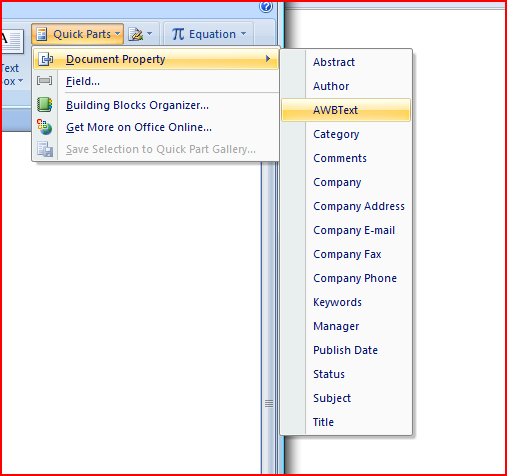
You can put these into the document itself. They’re like document ‘Fields’ in Word pre-2007, but these are much, much better. For a start, you can actually type into the quickpart and it’ll update the document properties – and when you save the document to SharePoint it’ll update the columns of the library! Very cool. Anyway, I updated my Word template from my previous example…
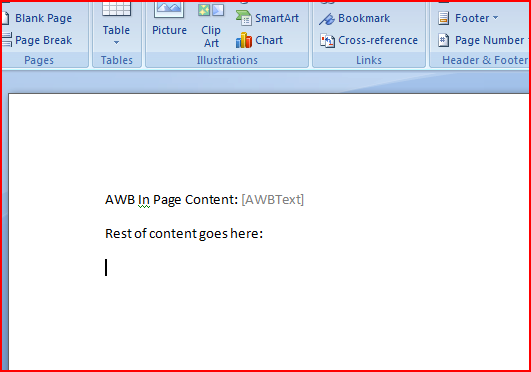
I then created a new document. Note that the AWBText field in the Document Information Panel and the Quick part is linked – I typed in the value in the document and it was reflecting the Document Information Panel.
I then converted these document. This resulted in:
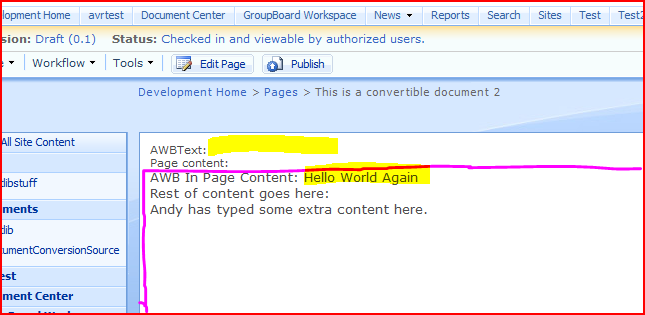
Okay, so I’ve scribbled on this a bit. The area outlined in the purple-pink colour is the content of our document that we converted. You can see that this includes the value of the ConvertableDocument‘s AWBText column. Hurrah! However, above this is the value of the AWBText column on the ConvertableDocumentPage – and it is still empty. In other words, the original document’s metadata is now in the page content – but it still isn’t stored against the Page as metadata. This isn’t really suitable for our customer – they need that column data against the Pages for their navigation. Bah!
Bespoke Coding
Okay, I started to wonder if I could fix this via custom code (i.e. some sort of Feature). I dug through some of the hidden properties of my source ConvertableDocument and destination ConvertableDocumentPage using SharePoint Manager. I knew that there must be some sort of connection as if you Edit the ConvertableDocumentPage is shows you that is has a source document, and lets you edit that document instead. Therefore, they must know where they came from.
In SharePointManager, I found some interesting fields. The ConvertableDocument content type I’d created had a property RcaPageID, which was a GUID. ‘Rca’ stands for ‘Rich Client Authoring’, which is what they seemed to call this page authoring technique until some decided to call it ‘Smart Client Authoring‘ instead. Certainly, internally it’s normally referred to as Rich Client Authoring, or ‘Rca’.
I then checked the ConvertableDocumentPage type, which had a property RcaSourceDocID . This was a GUID, and this ID matched the RcaPageID of the document we used to create the page. Thus, and I’m pretty sure about this, it’s the connection between the source Document and destination Page.
Therefore, I could build an event handler that (when a page is updated or created) gets the Page’s source document, sees what columns they share, and copies across the values of those shared columns. Actually, it’d probably have to exclude some (like title), but you get the idea. Also, it’d have to run a query across all the documents in the site collection, but I’m pretty sure that this is possible.
I like this solution, and think it’s a fairly straight forward, generic candidate for a feature, but unfortunately our customer is unable to make server configuration changes – like installing new features. So that rules that idea out… damn.
Don’t use the Document Conversion Service
I know, this seems a bit crazy – but you could author your content in Word and just copy and paste the content into your pages. This is what our customer was doing. I know, it seems a little crazy to me too, but if you lock down the styles available in a Word template, then the code you’ll copy will have consistent CSS styles in it, and you can prevent any inline CSS through that restriction too. It has no server footprint and no duplication of metadata – but you still have to store the documents (which might require column data too).
So those were the options I was able to come up with. I like the coding option – an event handler could be a very elegant way of dealing with this.
Document Conversion Service doesn't map column data – Part I
(For the purposes of this post, I’ll use Pages with a capital P to mean items in SharePoint of a Page content type, or a child content type of Page. I’ll also refer to all content types in italics)
One of our customers wants to author their Pages in SharePoint in Word. Sounds like a case for the Document Conversion Service – author the content in Word, and then convert the Document to a Page. There is a catch though – they’re wanting to capture some meta-data about the document too, such as business unit, review date, department that ‘owns’ the page, etc.. What would the Document Conversion Service do with this information? I didn’t remember seeing any way of setting up mappings between fields. Would the metadata be copied if both the Document and Page content types shared the same site column?
To find out, I did a bit of testing. Much of what I did was actually stuff like creating a new Page layout, and then customizing it. There are better articles about this that my notes, but I’ll include all the steps. (I do assume that you have the document conversion service running and enabled on your site collection though.) I did the following:
I created a new Site Column – I called it AWBText. It was just a text column.
I created a new Document content type which used that new column. I called this content type the ConvertableDocument content type:

I then created a new Page content type. I called this the ConvertableDocumentPage content type:

I made sure that that also used the AWBText column – and the out-of-box ‘Page Content’ column. This column will hold the content of the converted document. You should probably add another column for holding the style information, but I didn’t bother (‘cos I didn’t need it for the test). You could create your own, but I chose just to use the same ones as the Article Page content type – after all, the data (page content) is still the same, and this is why different content types can share the same columns.
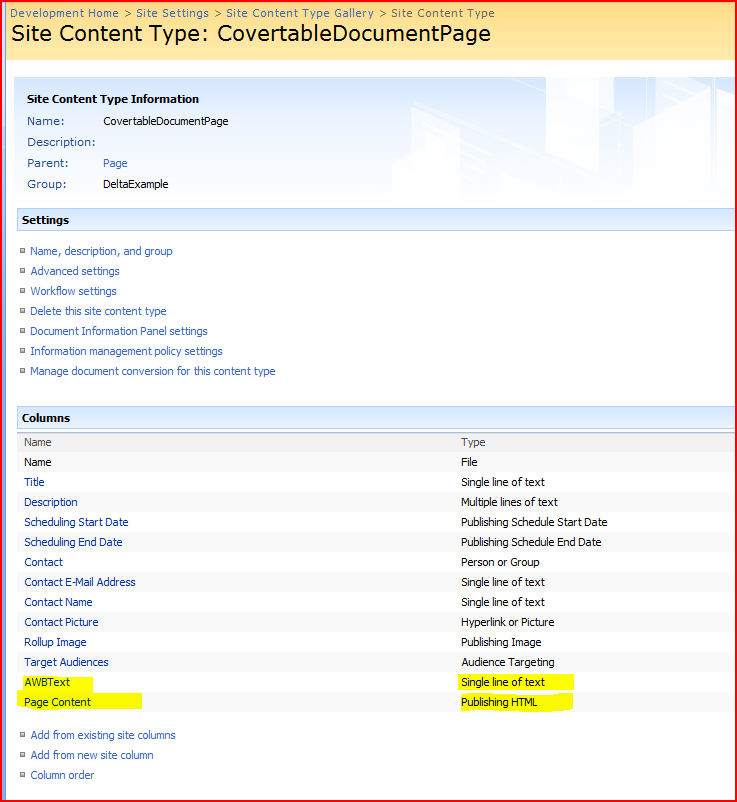
So, now I’ve got my two content types I’m going to test with, and they both share the AWBText column. However, the ConvertableDocumentPage content type needs a page layout to, well, define how the ConvertableDocumentPage‘s content will be displayed. I cracked open SharePoint Designer, opened my site, and created a page layout:


This gives you a page layout to put your content controls into. We’ve only got a couple:
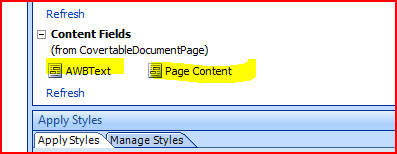
I created a page layout. Here’s the code and how it looked in SharePoint designer:

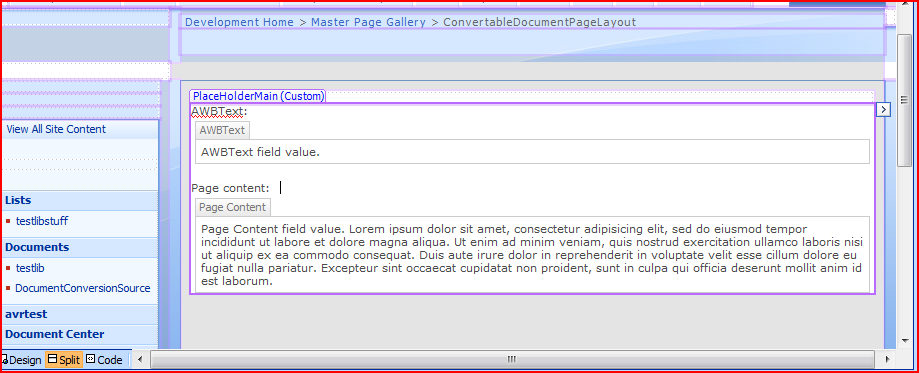
As you can see, I’m displaying my AWBText field at the top, with the converted content from our converted ConvertableDocument below. Both fields also have labels. I published and approved the layout.
Next, I set up a template Word document – I went to the ConvertableDocument content type’s advanced settings, and edited the template.
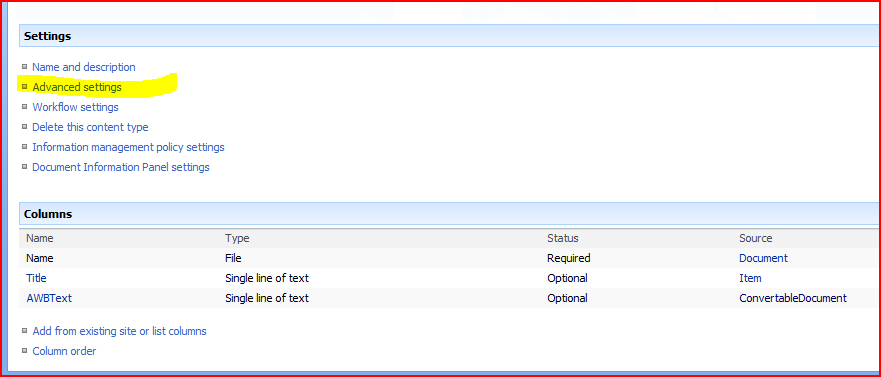
I then just saved the template without making any changes – I’ve found that you need to do this to get the Document information panel to work correctly.
Next up, I set up the document conversion through ConvertableDocument content type’s settings:


Then the complex form of the conversion setup:

Take a moment to look at that form. I’ve defined that I want to convert my ConvertableDocument to a page layout of ConvertableDocumentPageLayout – which implies a content type of ConvertablePageLayout. I’m putting the content of the converted content into the Page Content column, and removing any styles (because, as mentioned above, I don’t have a suitable column to put the style information into). Note that there are no settings for other data mappings – no columns of the document to columns of the page mapping.
I saved these settings, added my ConvertableDocument type to a Document Library, and added my ConvertableDocumentPage type to the ‘Pages Library’. Then I created an example document. Note the Document Information Panel at the top shows my AWBText column (and the Title column), and I’ve put in some text.

I saved this, and in the document library I chose to convert the document to a web page:
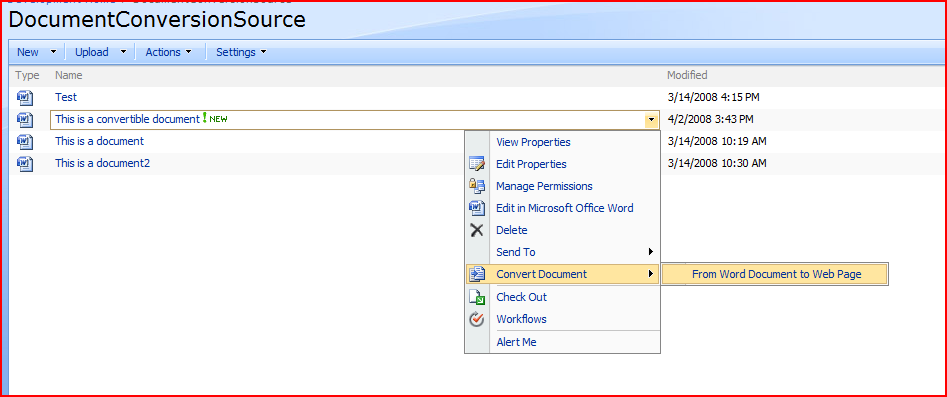

This resulted in a page that looked like:

And the document library looked like:
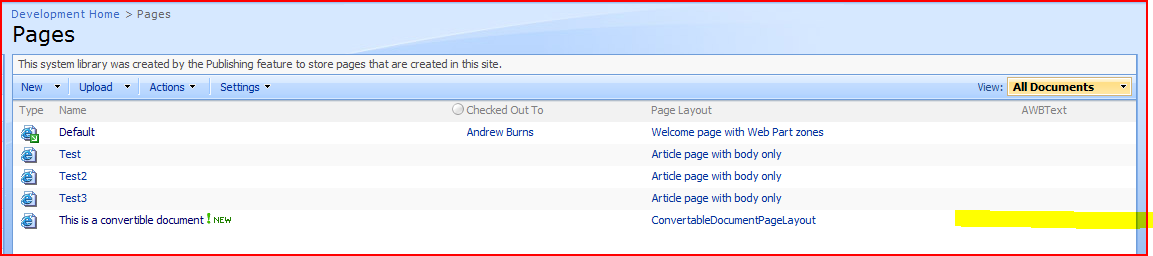
So, as we can see, the AWBText column has not been copied across, even though it is the same column. During the configuration process, there was no option to configure mapping of fields. It looks like the Document Conversion Service doesn’t map column data. In Part II, I’ll look at some options.
Duplicate rows from the SharePoint Lists webservice.
Edit: I’ve since learned more about this behaviour – but it’s still not very obvious
I found what I can only describe as a but in the Lists.asmx web service in SharePoint. I was using Lists.GetListItems to get a list of the folders in a Document Library, and I found that I was getting one of the folders twice. However, when I looked in SharePoint, there was only one, and my program showed that both these folders were supposed to be at the same URL. WTF?
Naturally, I went back and had a look at the XML I was getting back from the web service. I expected to get two, so I was somewhat surprised to get 3…

As you can see, 2 records have the same URL, the same internal ID (both of which have to be unique!), and the only difference is in the AWBMultiLookup column. This set alarm bells ringing. Firstly, I was surprised to see it in the results. In GetListItems you can define the fields you want returned in the responses (the ‘view fields’ ). I had only asked for the URL, the ‘link file name’ (the item’s name), and it’s ID. I’d expect to get some other details (the web services always seem to include more), but not field data.
Secondly, AWBMultiLookup is a multi-select lookup column. In other words, it looks up data from another list, and you can can select zero to many items from it. For my folder, I’d selected 2 options from this column (‘A’ and ‘C’), and now I have 2 records with the only difference being the value of the AWBMultiLookup column – ‘A’ or ‘C’. On a hunch, I went and selected a third option (‘B’), and my XML I was getting back became:

Yup, now I got 3 records with different values of AWBMultiLookup, rather than just the one. Clearly, and incredibly, the web service was returning a seperate ‘item’ for each value of the multi-select lookup column that was selected. I can’t think of a situation where that would be the desired behaviour – and everywhere else in the system, multiple values are just encoded into one string. Hence, I’m calling that a bug.
However, this raised a question. Elsewhere in the system I get just the one folder and it was definitely getting the multi-select lookup field correctly. I ran that code and found that the XML I got back was:

Yup, you’ll notice that the results from GetListItems this time shows all the values for the multi-select lookup in one attribute. What gives? What’s different about this query to the other one where multiple items would be returned?
Well, the only difference that seemed like it could be relevant is that this second query requests the ‘AWBMultiLookup‘ column in the ‘view fields’. I decided that I’d test this by modifying the view fields for my first query to include the AWBMultiLookup column like so:

Having done this, my query now worked as I’d expected it to in the first place:

Notice that all values are now encoded in the one attribute, and that I’m getting the two records I’d originally expected.
Or course, this doesn’t help me. When my application is browsing across folders I don’t actually know what the columns against folder really are, so even if I was happy to request the multi-select lookup fields (despite their being superfluous ), I can’t, ‘cos I don’t know what they are yet. I’ve gotta admit, though, that I’ve lost my temper at whoever made the web services work that way. It’s worth noting that the SharePoint API doesn’t behave similarly
One thing I haven’t checked yet is what happens if you hav many multi-select lookups. Combinatorial explosion anyone?
You can do a lot with page layouts…
I’ve been blogging a fair bit lately about Page Layouts – how they affect styles to hide bits of the page, how they are used to replace breadcrumbs and the like – but you can do a heck of a lot with them.
Quite a lot of your default master page is in ContentPlaceHolder controls. Those ContentPlaceHolder controls have default content – but your page layout can define Content controls which place content into those placeholders, overriding them. Of course, you still need to have all of the appropriate controls on a page – just removing the ‘Site Actions’ menu for everyone isn’t a good idea – but you can do a lot.
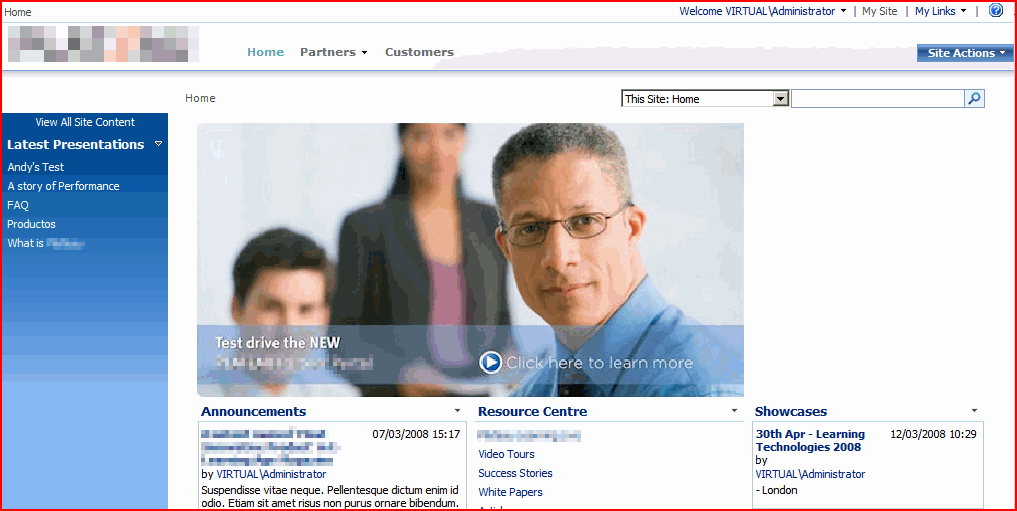
This sort of came up at the last SharePoint User Group meeting – Colin Byrne was demonstrating Silverlight in SharePoint (which apparently doesn’t work all that well yet, but shows promise). One of the demos he has showed replacing the left navigation with a Silverlight control, but used a neww Master Page do to that. I thought of a demo I’d done recently where I’d done similar – but with a Page Layout. I used this to replace the left navigation menu with a Web Part Zone:
Normal View
Edit View
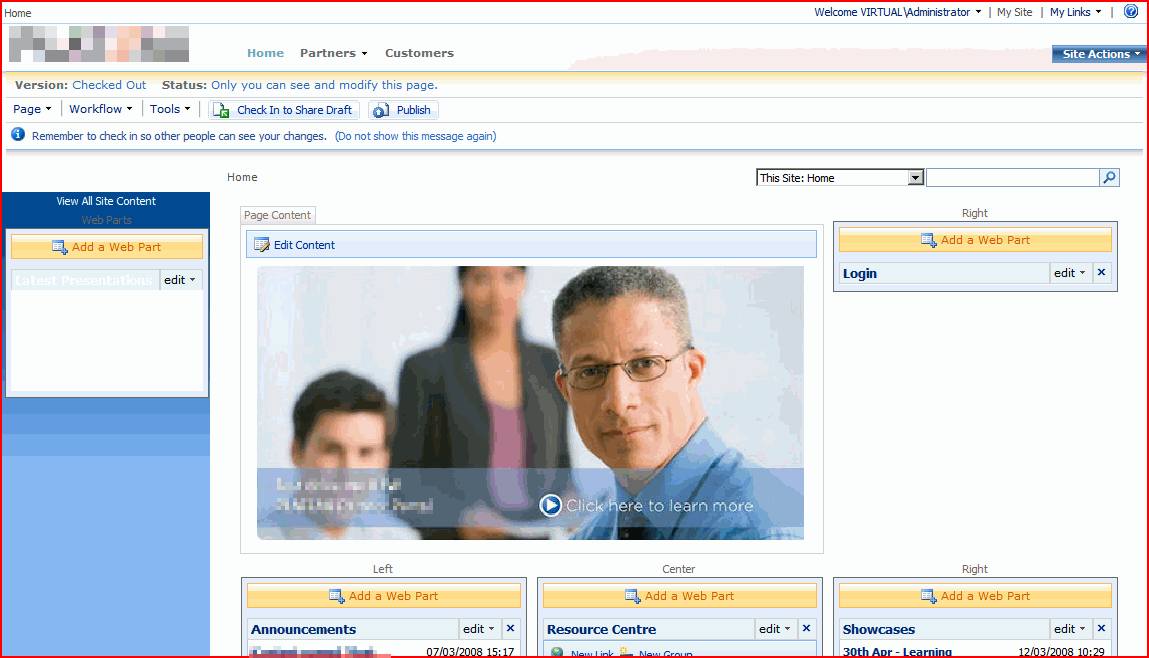
Believe it or not, this is actually the default master with a particular Page Layout that I made, and the ‘Simple’ theme applied. Actually, there are lots of bits of the page modified by the Page Layout. The ‘Site Actions’ menu and Top Navigation Bar have been moved up, for example. The Left navigation has been replaced by a Web Part Zone, and I’ve dropped a Content Query Web Part in there for a giggle. And the Search box has been moved down the page too.
You could do all of this with a Master Page of course – and in real life, you’d probably want to for most of those modifications. For some things, though, like replacing certain navigation controls (which is what some of the out-of-box page layouts do with title breadcrumbs) then I think that a page layout might be exactly what you want – so that you can have different forms of navigation for different pages using the same Master Page.
Anyway, I was surprised by how easy it was to do this. Given that the Master Page defines default content, much of what I did was just copy that default content into the Content control for the location that I wanted to put the control into – and voila!
RSS Aggregator Web Part
Folks are really keen on RSS feeds in SharePoint, but the RSS web part only receives feed from 1 location. Well, good news, as Eric Shupps created (a while ago, actually) a feed aggregator web part. That’s a useful thing to know – but it’s interesting that he hit the problem I have with RSS feeds – too many formats of them…
Error: "The document information panel was unable to load"
I was building a demo where I was wanting to show the document information panel in Word 2007 (which I think is one of the neatest features about it!) . It should look like:

But instead I was getting “The document information panel was unable to load“.

I couldn’t see a reason for this, but investigation found this post which shows the same error, and a solution in the comments:
The System Event Nofication Service (SENS) uses the same communication “channels” (not the correct word, but works) as does office products do in communicating with the server.
Stop and disable the SENS service on the server and everything will work perfectly.
So, open a command prompt and type:
net stop sens
Bit strange, but that fixed it for me. Also note the comment at the bottom that the Document Conversions service doesn’t work on a single server demo system like this.
The default locale of DateTime columns in the Dataview web part
More bugs in the dataview webpart – this time not being able to set the default locale for the page’s dates to being UK. When you add a datetime column to the view, if you look at the code, I can see the locale of 1033 (en-us), and the date formats available are only US format.
On my system, however, while the date formats appear to be US format in SharePoint designer, the code for a datatime column that I add to the view contains the 2057 locale (en-gb) , and the date formats display correctly in the page itself.
So it’s almost like SharePoint designer thinks it is working with US date formats, despite the settings of the Page Editor settings page, the Regional settings on the machine, and the Regional settings on the site all being set to UK date formats. I don’t know if I’m missing a setting somewhere, but if I am, I really don’t see it!
This problem can be fixed by resetting the locale by hand in the code, but really, you shouldn’t have to.
Fixing the comparison operators on the DataView web part filter dialog (maybe)
As mentioned previously, I was having some problems with not having the right operators in the Filter Criteria dialog of a DataForm Web Part. Although the field I was trying to filter by was a date, I was only being shown the options as if it was a string:

Well, proving that invention is 99% perspiration, I managed to find a solution. On the list on my customer’s system there was a Lookup column which referred to a list that no longer existed. Note the lack of List name for where it’s getting information:
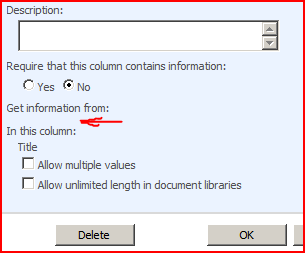
When I removed that column from the list, I could filter correctly again:

This is despite the fact that the broken lookup column is not used either in the display on the DataForm webpart, or in it’s filter. Merely its presence is enough to screw things up. Note that this is a different solution to other ideas that have been suggested elsewhere.
 Andy Burns' Blog