The DatePicker control contains a ‘gap’ of a couple of pixels on the left:
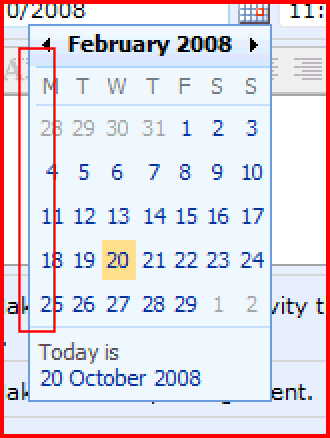
The DatePicker control contains a ‘gap’ of a couple of pixels on the left:
So, yesterday’s discussion of the problems with master pages for Publishing and Meeting sites raised a bit of a question with my colleagues. If a site (SPWeb object in the code) has both MasterUrl and CustomMasterUrl properties, how does a page ‘know’ which one to use? Why do publishing pages use the value in CustomMasterUrl, and other pages use MasterUrl?
Well, to find the answer to that, you’ve got to look in the code of the .aspx content page. Here’s the top of one in SharePoint Designer:

Yup, there is a MasterPageFile as per standard ASP.NET. However, the value of this isn’t normal – it’s not the URL itself, but rather a token that gets replaced at runtime.
If you look in, say, the default.aspx page on a team site, you’ll see that it uses ~masterurl/default.master.
If you look in, say, the default.aspx page on a meeting workspace, youll see that it uses ~masterurl/custom.master.
If you look in publishing pages, though, you have to look at the page layouts (which are the actual .aspx pages being used). These don’t have a have a MasterPageFile defined – what gives? Well, they inherit from the Microsoft.SharePoint.Publishing.PublishingLayoutPage class, which sets the master page file internally during OnPreInit! You can see in Reflector that it’s using CustomMasterUrl though.
So I’ve been working on branding meeting workspaces and looking at some of the issues within them. I took a look at the branding I’d been building on a meeting workspace:
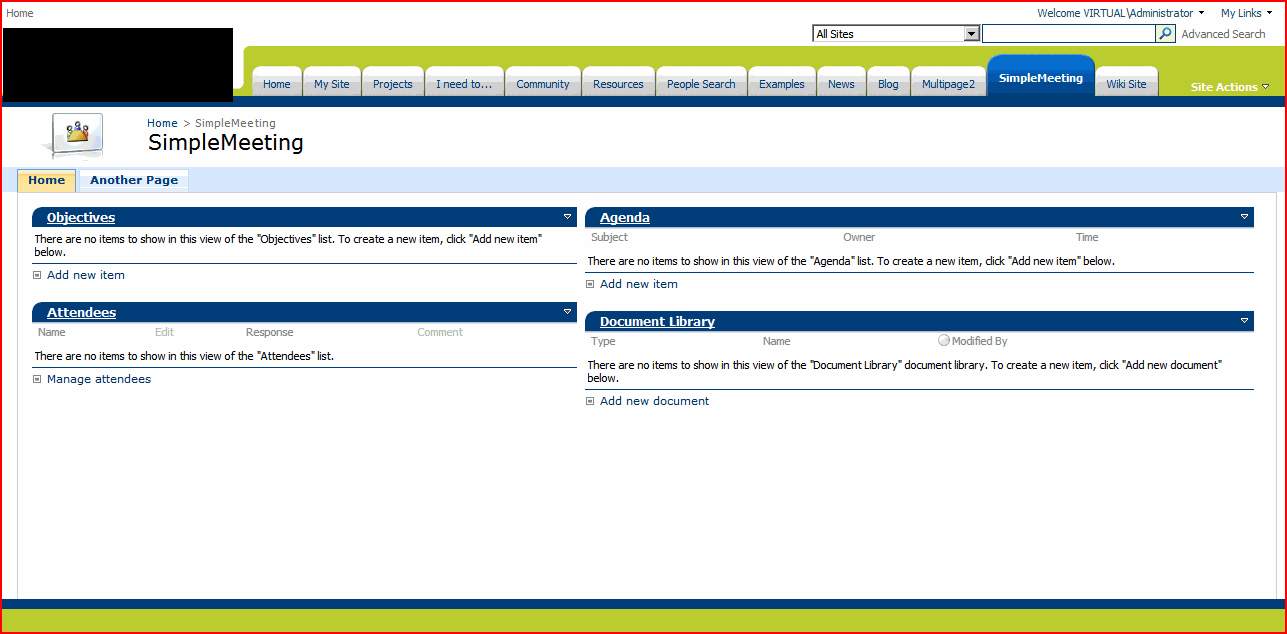
Yup, lots of nice rounded corners, but you can see that the meeting workspace tabs are currently unstyled. I decided I’d try to make them look just like the ones at the top, and replace that pale blue bar with the green one, like the one at the top. Continue reading “What's up with the awful code in Meeting Workspaces?”
I’m beginning to hate the SharePoint DatePicker control. It displays with different widths:
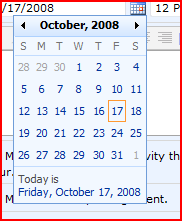

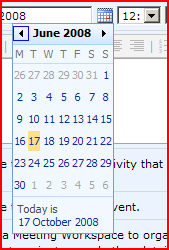
What defines the width of this control? Damned if I can see – it appears to be the widest element within it. This means either:
This is probably less of an issue for Americans (right) than the British (left) – I presume that other Europeans will have the same issue.
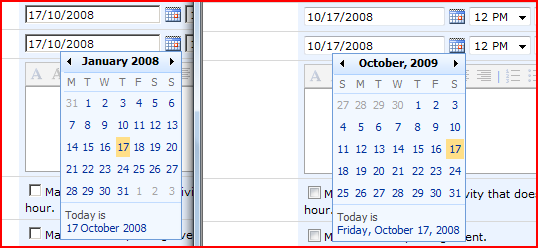
Certainly, this will result in some squashed looking calendars on certain months. Yet try as I might, I couldn’t get the calendar to fill an entire area.
And why does the American format give the day and the normal format not?
So, yesterday I was wondering about custom master pages for Meeting Workspaces. I found that Meeting Workspaces use their own master page (mwsdefault.master), which is referred to in the CustomMasterUrl property of the SPWeb object. As I noted, that sounds a lot like SharePoint publishing sites (i.e. sites with the Publishing Features enabled, like a Publishing Portal or a Collaboration Site).
This rang a bell with one of my colleagues, so he dug out some details. The publishing features let you select a Site Master Page and a System Master Page… Continue reading “Setting a Site Master on a Publishing site breaks Meeting Workspaces”
So, I went to the SUGUK meeting last week on the 16th at LBi’s Truman Brewery building on Brick lane. I was looking forward to it, though was disappointed to find that the brewery is now offices. Anyway,the subject was WCM best practices with Chris O’Brien and Riaz Ahmed, who’re always entertaining speakers. Continue reading “SUGUK Meeting: WCM Best Practices”
Irritatingly, in SharePoint Meeting Workspaces have a different master page to most sites (mwsdefault.master and default.master respectively). The differences are actually quite minor – the Meeting has a ‘Custom Tool Pane’ control, so you can add new pages, and a tab bar:
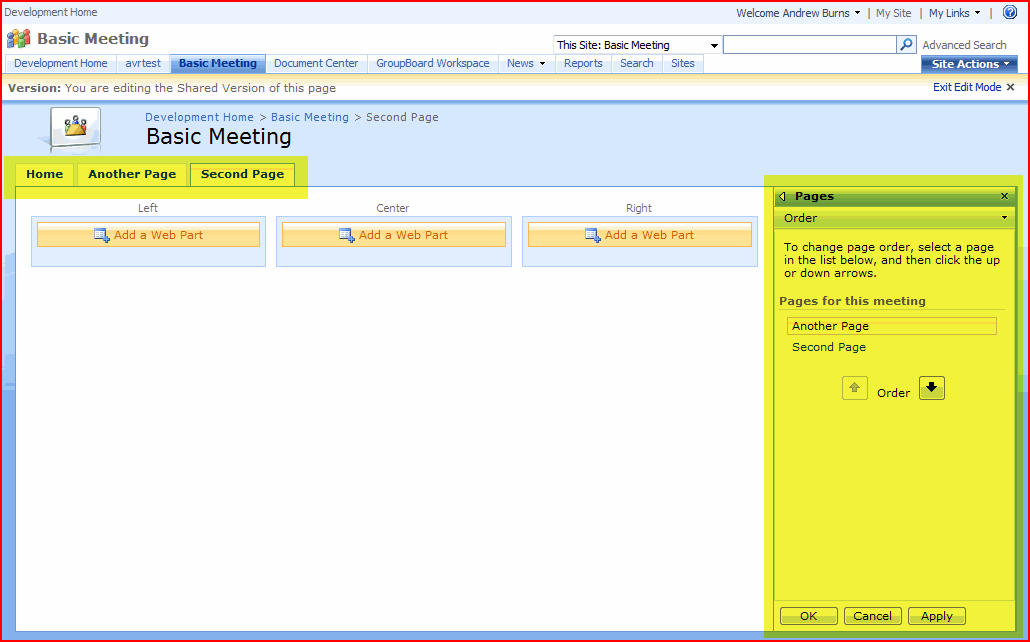
In the code, the pages are very similar, which makes it all the more irritating that they’re not simply the same. As far as I can see, there is no need for this – at least, nothing that can’t be dealt with by content placeholders – which is what they’re using to get rid of the left navigation. Anyway, I digress – the real question is can we customise them, and provide consistent branding on them? Continue reading “Custom Master Pages for Meeting Workspaces”
So, I was doing some testing of some branding, and I took a look at the Survey list. I tried filling out a survey and was shocked by a yellow screen of death:

This was because I’d set SharePoint up for debugging during development. The SharePoint error page appears:
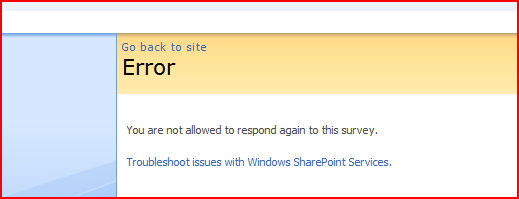
Well, the error is right – I was trying to fill in the survey twice. But it’s not like this is an unexpected error – it certainly shouldn’t be an unhandled exception!
What are the problems with this? Well, it kicks us out of the branding experience I’ve built, which is annoying. It doesn’t allow the user to navigate anywhere. And, dammit, it’s just bad practice! I mean, do these errors appear in the logs?
Don’t get me wrong, no code is perfect and exceptions will happen. That’s fine. But who the hell thought unhandled exceptions was a good bit of deliberate functionality?
Anyone else found other deliberately unhandled exceptions?
A while back I posted about the how daft that the datepicker control isn’t styled by themes, and is in the _layouts directory, so you shouldn’t edit them.
Well, a while later Michelle posted with a good idea of how to brand them – use an alternate CSS URL. I must confess, this tip passed me by until my recent branding efforts, and I discovered her tip.
So why does this work? Well, if we crack open the file iframe.aspx (which I still think is a bloody stupid name. I mean, the defining feature is the DatePicker control, not the bloody iframe it uses) we can see the code:
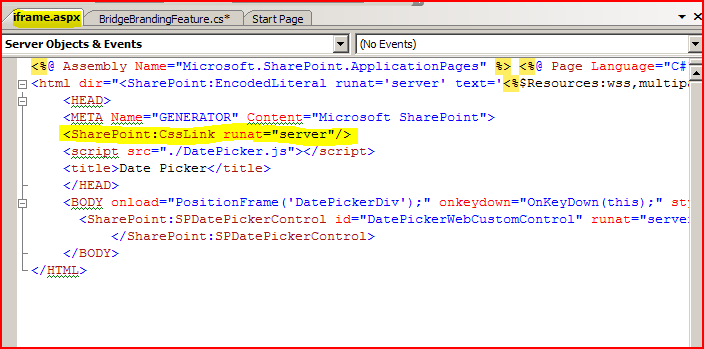
There we go – code to insert the alternate CSS url (but not themes – obviously).
So, I gave this a go:

Tada! Styled date picker, nice one Michelle. However, she notes that it has to be applied to a publishing site, or to a publishing site and all sites below it. Site collections based around a team site would be tricky. Normally, this page is used to set the alternate CSS…
[image of site]
… and, well, Team sites don’t give you that page.
However, we can achieve this in code! All the admin page does is change the SPWeb.AlternateCssUrl property for a site or set of sites. We could have a feature receiver (a bit of code that is run when a feature is activated or deactivated) to do this:
public override void FeatureActivated( SPFeatureReceiverProperties properties ) {
SPWeb site = properties.Feature.Parent as SPWeb;
site.AlternateCssUrl = "[Your URL here]";
site.update();
}
More evidence that brands are best applied by feature receivers. Maybe I should make an example of this…
I’d built a .wsp (Web Solutions Package) for a customer, containing the branding I’ve been working on. However, when they tried the command:
stsadm -o addsolution -filename branding.wsp
they got the error:
Object reference not set to an instance of an object. c:branding.wsp: The Solution installation failed.
Interesting – works on my machine. They were running the command as the ‘Administrator’ user on the SharePoint system. A bit of digging, though, showed that the problem was due to either:
Well, we tried running the STSADM command as the service account, and that appeared to work. ‘Course, this is all over the phone so I’m not certain what permissions that account has, but it appeared to run.
 Andy Burns' Blog