Previously I’d looked at having a search that shows thumbnails of images in SharePoint. I modified the results page to do this – but the results themselves would still show non-Picture items (e.g. documents, pages, etc.). In this post, I’ll configure up a new Search Scope for images only. Continue reading “Create an Image only Search Scope in Sharepoint”
SP2007 Search
Showing Thumbnails in Search
One of my colleagues was asking about building a search which would show thumbnails for images, and whether that was possible. I decided to try a 5 minute prototype, so I took a copy of the results.aspx page in my Search Center, and started hacking…
I have a Picture library with some images in it (they’re pinched from Flickr, so sorry for the copyright thing to their respective owners – but they’re lovely looking test data). You might notice that the images in the pictures Library are already thumbnailed:

Firstly, I took a look at all the xml I was getting back from the search results. (You can add to that.)
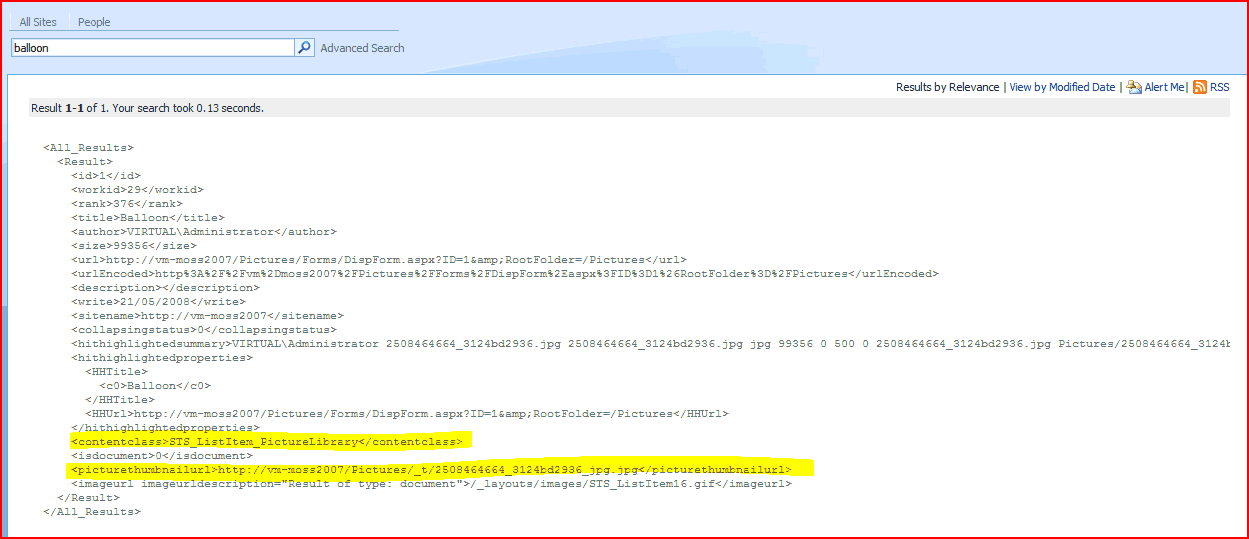
Great! So I’m getting the thumbnail for the picture through in the search results, and I can also identify what pictures are by the ContentClass. Nice one!

The first thing I noticed on opening up the XSL for the normal results page was that there is a section about showing a thumbnail. Normal search results don’t show a thumbnail though – so what gives?
Well, there are a few conditions before it’ll show the thumbnails – the ContentClass of the result (which is okay), the presence of a thumbnail URL, and the variable $IsThisListScope being true. I’m not sure what the $IsThisListScope variable is for, but I decided to delete it from the condition. As the other parts are met the results should show thumbnails for items which have them (i.e. Pictures).

And if I perform a search for, say, balloons, then I get some results with thumbnails:

Now, it’s worth noting, this page will still show non-pictures results – just my results didn’t have any. The next step would be to create a scope to only include images.
The curious incident of the date column in the night-time
I have been tearing my hair out over a problem with dates and timezones. We have a site column ‘Document Date’ that we are using in our search results page. It only holds a date.
Our client noticed that some dates appeared on the search results page as a day earlier than the value in the lists themselves. For example, the list would show a document date of the 8th of May, but the search results would show the 7th of May. Curious, and the start of a bit of a detective story… Continue reading “The curious incident of the date column in the night-time”
Hit Highlighting in SharePoint Search Document Titles
I came across an interesting behaviour in a search results page I’ve been working on. I’d added some code to do search highlighting on the results of a query. Here’s an example of the results I got for a search for ‘Barnacles’:

The observant amongst you will notice that the titles all contain the word ‘Barnacles’, but only some are highlighted – specifically where the word barnacles is not the last word before the dot-extension of the file name. I did some further testing and found that the search does recognise the word ‘Barnacles’ in the file name, but the hit highlighting doesn’t seem to. Continue reading “Hit Highlighting in SharePoint Search Document Titles”
Hit Highlighting inside Adobe PDFs using SharePoint Search
So, I’ve posting about some work I’ve been doing with SharePoint Search. Now, to pull it all together – I’ve been trying to do hit highlighting inside Adobe Reader, so if a user clicks on a search result Adobe Reader opens and automatically searches for occurances of the search term. Doing this requires knowing your file extension (so you only process PDFs this way), knowing the query string parameter for what is being searched for, and that you can pass parameters into Acrobat Reader. I’m not going to go too much into that last part, but you can find documentation about this on Adobe’s website (pdf). Continue reading “Hit Highlighting inside Adobe PDFs using SharePoint Search”
Using a Query String parameter in the Search Results Web Part
Further work on fixing a colleague’s code. Like some of the posts I’ve found, he seems to have thought that to get the query string parameter he’d have to use Javascript – something like this. However, I found myself thinking of the Data View web part – it allows parameters based on the query string. Most people know about that. What I found, and what I think some folks don’t realise, is that the Search Core Results Web Part allows you to have query string parameters too… Continue reading “Using a Query String parameter in the Search Results Web Part”
What columns can I use in my Search Results?
In a previous post I described adding the FileExtension column to the XML you get back from a SharePoint search, so that you can use it in your results page. This raises the question – what columns are available for use in the Selected Columns setting on the Core Search Web Part?
Well, these columns are Managed Properties, and they’re configured on the Shared Service Provider (SSP)… Continue reading “What columns can I use in my Search Results?”
How do I get the File Extension in my Search Results?
Following on from my previous post, I’ve been looking some more at the code that one of my colleagues has created for styling up some search results. In it he needs the file extension for the item resulting, and he does this by, um, assuming that it’s the last 3 letters of the items URL. Yes, I am not amused. For example, if you look at the results from my last post… Continue reading “How do I get the File Extension in my Search Results?”
How do I get the XML of my search results?
So I’ve just started customising SharePoint Search results for the first time. It’s an area that I’ve never really touched before, to be honest – I’ve set up the crawling, and that’s the limit. Now I find myself reverse engineering a colleagues code in order to fix it.
Well, from what I can fathom, SharePoint search results actually come from the Search.asmx webservice in the _vti_bin of your site. The results are actually returned as XML, and in the web parts (not sure which ones, but certainly the Search Core Results web part) you then render this XML to HTML via XSLT. (If that means nothing to you, I’m afraid you’ll have to look it up. That concept is a whole can of worms. Maybe even a crate of worms. Anyway…)
An obvious question is, what does that source XML look like. Well, it’s whatever you get back from the web service, and there are various ways of find that, but I found a neat little solution on a post from Tobias Zimmergren’s blog (in fact, it’s an interesting looking series for a search rookie like myself – I think I’ll have to read that). I’ll blatantly plagiarise that in a bit. Basically, his idea was to define some XSLT that just emits the XML unaltered, and then look at what you’re getting back from the search service on the search results page.
So, to test, I copied the normal search results page (mine was in a search center) to give myself somewhere isolated to test in. I went to it – and it was all empty. Not surprising – there were no web parts. I added a Search Core Results web part:

You might want to add a Search Box web part to give yourself somewhere to enter your search terms, though I’m a bit of a geek and was typing directly into the URL of the browser. For example,
?k=barnacles
will search for documents about, um, barnacles.
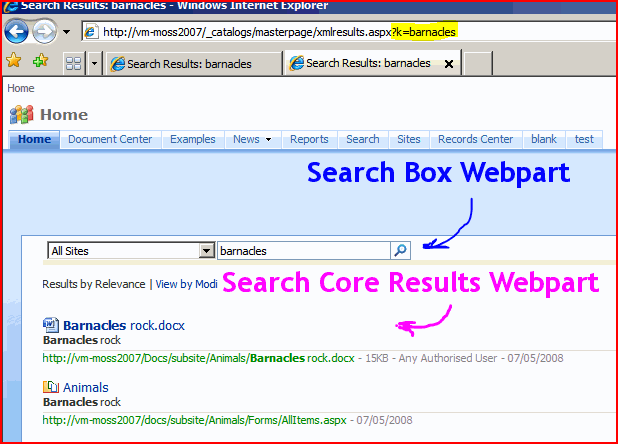
Fine. Now we need to apply the XSLT. Edit the Search Core Results Web Part:

and edit the XSL:

Blatant Plagiarism alert – Tobias’ XSL was just:
<xsl:stylesheet version="1.0" xmlns:xsl="http://www.w3.org/1999/XSL/Transform">

<xsl:output method="xml" version="1.0" encoding="UTF-8" indent="yes"/>

<xsl:template match="/">

<xmp><xsl:copy-of select="*"/></xmp>

</xsl:template>

</xsl:stylesheet>
Note: Don’t just copy the above text – use this link. WordPress has changed the speechmarks in the code above, and it won’t work.
Apply it and voila – XML:

Now I can get on with Styling it.
Changing the SmallSearchInputBox delegate control
A colleague of mine was wanting to make some changes to the SmallSearchInputBox delegate control in SharePoint 2007. That’s the control that appears on most pages, looking like:

This control is a ‘Delegate control’ – that is, you can create features to override the currently used control. What my colleague wanted to do was not display the ‘Scope’ drop down list, the Advanced Search link, and to include prompt text (something like ‘Enter Search…’). A quick dig into the FEATURES folder in 12 Hive showed that the control had a number of properties.
(The features that this information applies to are the OSearchBasicFeature and OSearchEnhancedFeature. Both contain files called ‘SearchArea.xml’, and that contains the code below. I found the folders with this in:
%12 Hive%TemplateFeaturesOSearchBasicFeature
%12 Hive%TemplateFeaturesOSearchEnhancedFeature )
<?xml version="1.0" encoding="utf-8" ?>

<Elements xmlns="http://schemas.microsoft.com/sharepoint/">

<Control

Id="SmallSearchInputBox"

Sequence="25"

ControlClass="Microsoft.SharePoint.Portal.WebControls.SearchBoxEx" ControlAssembly="Microsoft.SharePoint.Portal, Version=12.0.0.0, Culture=neutral, PublicKeyToken=71e9bce111e9429c">

<Property Name="GoImageUrl">/_layouts/images/gosearch.gif</Property>

<Property Name="GoImageUrlRTL">/_layouts/images/goRTL.gif</Property>

<Property Name="GoImageActiveUrl">/_layouts/images/gosearch.gif</Property>

<Property Name="GoImageActiveUrlRTL">/_layouts/images/goRTL.gif</Property>

<Property Name="UseSiteDefaults">true</Property>

<Property Name="FrameType">None</Property>

<Property Name="ShowAdvancedSearch">true</Property>

</Control>

</Elements>
This shows a property ShowAdvancedSearch which sounded pretty promising for turning off the Advanced Search link. We decided to see what other properties were available, and found a good article by Clint Cherry about the SmallSearchInputBox control, and the MSDN docs. The Property tags in the XML for the delegate control set the properties of the web control class – e.g. GoImageUrl matches the GoImageUrl property on the class. Much to our pleasure, we found the QueryPromptString displays text in the search control which vanishes when it receives focus, and the DropDownMode property allows us to turn off the scope dropdown list. Hurrah!
For the values that you can set the drop down mode to, see the MSDN docs again
 Andy Burns' Blog