Programmatically create and configure Mail Enabled lists

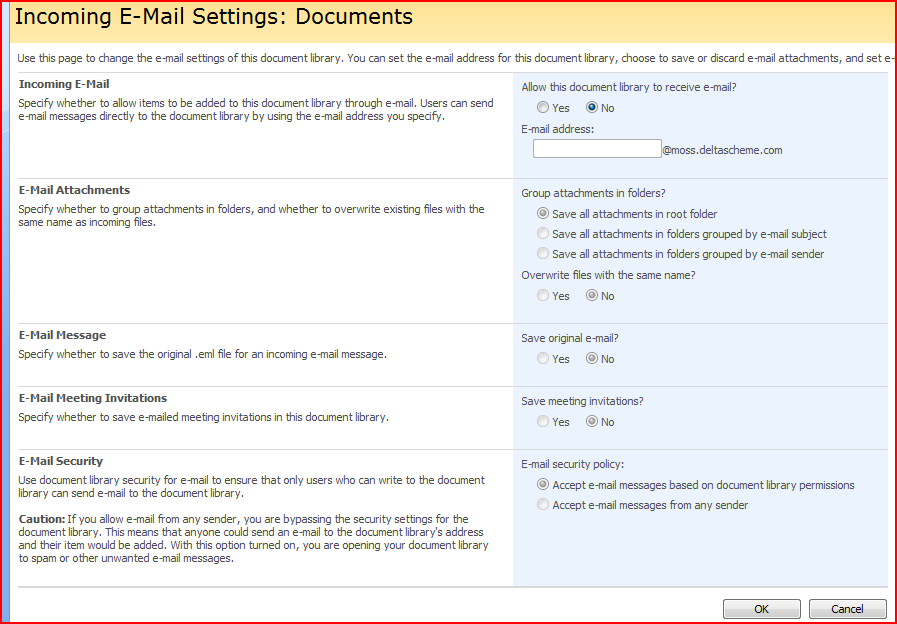
Being able to mail enable a sharepoint list is pretty cool; once enabled an email can receive email, save attachments, etc.. But what’s the address of the lists? How do you enable it? How are attachments stored, and how do we decide who to let email it?

emailsettings

Well, for a customer we wanted to email enable a list with an address based on the site’s title. This meant that the site would have to be created before we could enable the list. So, I stapled a feature to the site’s definition, and used a feature receiver to run my code. Continue reading “Programmatically create and configure Mail Enabled lists”

Programmatically create and configure Mail Enabled lists

Content Approval Statuses

I keep getting questions from customers about what statuses are used in Publishing and Content Approval, and who can see what items in what status. It’s a little complex, as it depends entirely upon your configuration of content approval and versioning settings. Continue reading “Content Approval Statuses”

Content Approval Statuses

Office 2003 and SharePoint

One of the main selling points of Office 2007 (to me, anyway) is it’s integration with SharePoint 2007. However, customers usually seem to still be using Office 2003, and this degrades the user experience. One of the main things that irritates is Check-out/check-in policy, and users just opening things in Read-only mode.

Well, again, Ton Stegeman has a solution. As one of my colleague’s comments ‘Smart man, that’.

Office 2003 and SharePoint

Mailing an Active Directory Group

This was something that I set up in our offices, and was trying to set up for a client – but it turned out that there were a few more components involved than I’d first realised.

We have an AD group of ‘All Staff’ which contains, um, all staff. We also have a ‘Company Announcements’ list, and we wanted to send any announcements added to that list to all our staff. As an administrator, I could add an alert for the ‘All Staff’ group ( on the list click List Settings > Alert Me and then enter the group we want to email)

The ‘All Staff group’ is a Mail enabled security group, with it’s own address – e.g. staff@example.com. The puzzle for me (not being an exchange or AD expert) was that in that case, what resolves the addresses? I’d thought that the group being mail enabled meant that you could resolve the email addresses of the users within the group – but what does that? Well, Exchange, as it happens, though I’m not sure how to configure that. The upshot of it is, though, that the AD group you want to mail needs to be mail enabled, and you may need to talk to your exchange guys too.

This is unfortunate, as in a lot of organizations making changes to AD can be a tortuous process. Still, if there is an appropriate group you can email then this is a quick win with things like Announcements lists.
Mailing an Active Directory Group

Roll up content by content-type

Pointed out to me by a colleague (ages ago!) – Ton Stegeman’s ‘Content by Type‘ web part. A good way of rolling up content of diverse types, without lots of XSL. If your content type structure is right, may well be other ways of doing this (the content query web part and data view may work) – but this is quite a nice looking tool, and simpler. Need to download and have a play sometime soon.

Roll up content by content-type

Highlighting tabs in the top navigation

We’ve got a customer who’s top navigation tabs aren’t being used as links to content in SharePoint. Instead, these tabs take users to other parts of their system, which is maybe fair enough given that the left navigation also gives them the same sort of access; indeed this duplication of navigation is often a source of consternation with clients.

Anyway, they’ve now added site that they do want linked from the top navigation bar. Therefore, if you click on this tab, they want it to appear highlighted – and it’s the only tab that would.

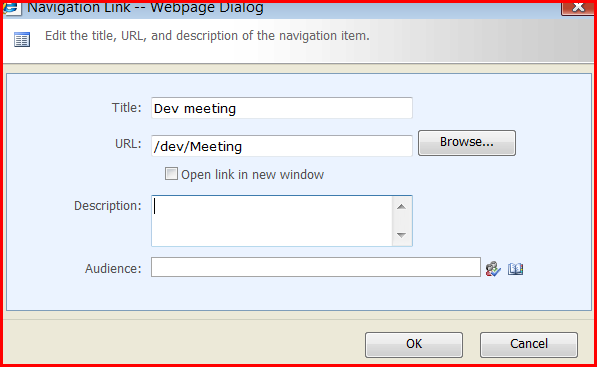
The site in question isn’t a subsite of the root site of the site collection, so I must confess, I didn’t think you could do this. They emailed and asked, though, and I suggested that the full URL that they were using (e.g. http://sharepoint/somesite/tabsite) wasn’t a good idea – as if they extend their web app for an extranet that link won’t work. As it transpired though, they’d thought to try a relative URL (e.g. /somesite/tabsite) and that worked nicely!

I had to check:

nav-link

showing:

highlighted-top-nav

There we go, a site 2 levels down, highlighted in the top nav correctly!

I suppose it makes sense that the relative URL might work – but I’d sort of assumed that the manual links wouldn’t undergo the same checks as the ‘show subsites’ links would.

Highlighting tabs in the top navigation

Custom Email Alert Templates for individual lists

Over time my inbox fills with notes of things I want to blog about – even if just as notes for myself in the future. This was one that I’d forgotten about – you can set an email alert template for an individual list! Really, it’s setting up the Alert Template (in a copy of AlertTemplates.xml), setting that that file can be used for alerts (via STSADM), and then setting that alert template to be used through the object model.

You also get to run a CAML query on the list, and access to the before and after values for items, when filtering what things to send emails about.

It’s all in this very good article.

Custom Email Alert Templates for individual lists

Programmatically disable page layouts

I’ve been meaning to write about this for a while – how to programmatically disable page layouts for a site in SharePoint, similar to how you’d do so with the ‘Page Layouts and Site Templates’ page in the site settings. You can also specify what page layouts are allowed, if you are defining your own Site Definition. But someday, maybe you’ll have to do it through code.

I’m pretty sure that I read something that set me going on this, but I’ve lost the link 😦 Continue reading “Programmatically disable page layouts”

Programmatically disable page layouts

Programmatically create pages – and Add Web Parts

I had an interesting problem recently with a Site Definition. I was trying to create a publishing page, which would not create as the correct content type. I still haven’t got to the bottom of why.

However, time was limited, and we were going to have to create a feature receiver to staple to our site definition anyway, so I had a look at creating a publishing page programmatically.

We needed a feature receiver as the customer wanted the home page of their site to have a ‘Search Box’ which would ‘Search this site’, but go to a custom results page in a Search Center. My plan was to use a Search Box Web part, configured to go to a custom results page, and to append the query term:

site: [url to site]

e.g. site:http://sharepoint/finance/

Naturally, you don’t know the URL of the site until the site has been created – so this web part would have to be created programmatically. Continue reading “Programmatically create pages – and Add Web Parts”

Programmatically create pages – and Add Web Parts

What do out-of-box pages do with their Breadcrumbs?

As I’ve described before (and repeatedly bemoaned!) some page layouts hide the page level breadcrumb and display their own. Worse – they don’t all do this in the same way! All of this continues to feed my idea that you shouldn’t use any of the OOB publishing sites if you can help it.

However, sometimes we don’t have that luxury (i.e. I’ve never had that option) – so what do those crazy out-of-the-box page layouts do with their breadcrumbs? Well, Martijn Molegraaf has been kind enough to provide a chart. Nice one. And I feel your pain.

What do out-of-box pages do with their Breadcrumbs?